Somewhere along the way, leadership became confused with emotional self-sacrifice.
Many leaders were taught that being "good" meant always being available, always accommodating, always understanding, and always carrying the emotional weight of everyone around them.
And while empathy absolutely matters, there is a difference between leading people and losing yourself trying to save them.
That difference matters more than ever right now.
Because many leaders are exhausted. Not because they do not care, but because they care deeply and were never taught where healthy leadership ends and emotional over-functioning begins.
Leadership was never supposed to mean:
- absorbing every emotion in the room
- avoiding hard conversations to keep people comfortable
- carrying responsibility for everyone's happiness
- fixing every problem yourself
- making work feel perfect all the time
- being endlessly accessible at the expense of your own wellbeing
Yet so many leaders quietly operate this way every day. And eventually, it catches up to them.
Not all burnout comes from workload. Sometimes it comes from the invisible pressure leaders place on themselves to emotionally hold everything together for everyone else.
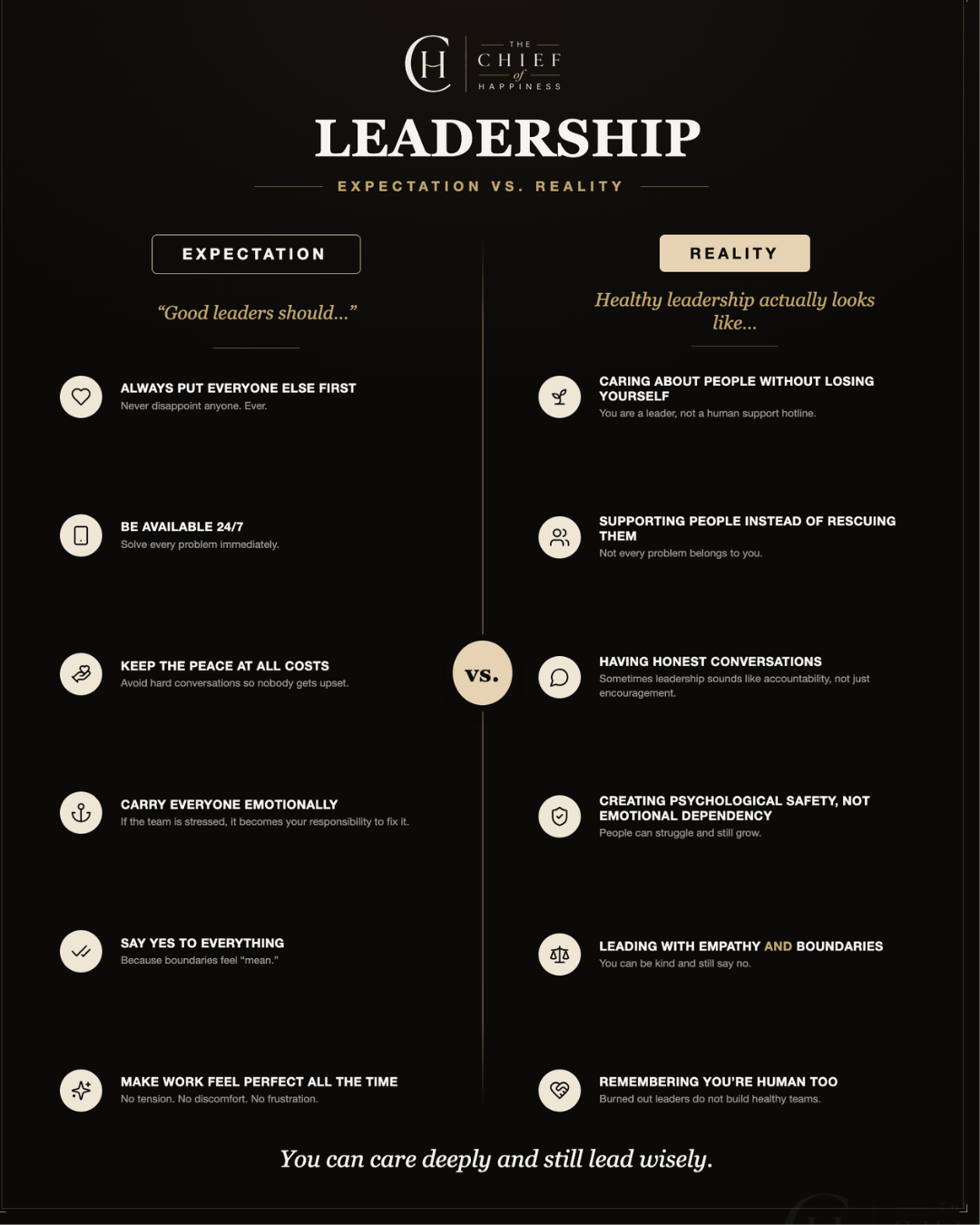
Leadership: Expectation vs. Reality — The Chief of Happiness
When Leadership Turns Into Emotional Overload
The healthiest workplace cultures are not built by leaders who rescue everyone. They are built by leaders who create trust, clarity, accountability, communication, and psychological safety.
There is a difference.
Healthy leadership is not about carrying everyone emotionally. It is about creating environments where people feel supported enough to carry themselves too.
Psychological Safety Is Not Emotional Dependency
Psychological safety does not mean avoiding discomfort. It means creating environments where people can speak honestly, learn, grow, ask questions, make mistakes, and navigate challenges without fear or humiliation.
Strong leadership is not emotional dependency. It is emotional intelligence paired with healthy boundaries.
The strongest leaders I have worked with are not the ones trying to be everyone's therapist, fixer, or emotional lifeline. They are the ones who:
- communicate clearly and consistently
- create stability through accountability with compassion
- support growth instead of rescuing people from discomfort
- lead with empathy while still maintaining boundaries
- understand that trust matters more than perfection
And maybe most importantly — they remember they are human too.
Supporting People vs. Rescuing People
Leadership is not about never disappointing anyone.
Sometimes leadership requires difficult conversations. Sometimes it requires accountability. Sometimes it requires saying no. Sometimes it requires making decisions people may not immediately like.
That does not make someone a bad leader.
Avoiding every uncomfortable moment in an effort to protect people often creates more confusion, resentment, and dysfunction over time. The short-term peace becomes a long-term problem.
Healthy Leadership Requires Boundaries
You can care deeply about people without abandoning yourself in the process.
And honestly, the leaders who learn that distinction tend to build the healthiest teams of all.
Burned out leaders do not build healthy teams. Burned out leaders build teams in their own image — reactive, over-extended, and unsure where the work ends and the person begins.
Workplace Culture Starts With Human Leadership
Workplace culture improves when leaders stop trying to perform perfection and start building honest, human-centered environments rooted in trust, communication, and growth.
That kind of leadership development is not soft. It is strategic. Teams that feel psychologically safe, clearly supported, and led by someone with healthy boundaries outperform teams that are managed by someone running on empty.
The work of employee engagement is not about perks and programs. It starts with the person at the front of the room — and whether they have been given permission to lead like a human being.
You can care deeply. You can be empathetic. You can be genuinely invested in your team's success.
And you can still have boundaries. Still have honest conversations. Still hold people accountable. Still say no when you need to.
That is not a contradiction. That is healthy leadership.
Frequently Asked Questions
What is psychological safety in the workplace?
Psychological safety is an environment where employees feel safe to speak honestly, ask questions, share ideas, and make mistakes without fear of embarrassment, punishment, or humiliation. It is not about eliminating discomfort — it is about making discomfort safe to navigate.
What causes leadership burnout?
Leadership burnout can come from constant emotional pressure, lack of boundaries, unclear expectations, people-pleasing, and feeling responsible for fixing every problem or carrying everyone emotionally. Many leaders never learned where their responsibility ends — and that gap is exhausting.
What does healthy leadership look like?
Healthy leadership balances empathy with accountability. It creates trust, communication, clarity, and support while also maintaining healthy boundaries and encouraging individual growth and responsibility. You can be deeply caring and still lead with structure and honesty.